― By Carmen F. Alfonso, D.O.
The Hormones Quietly Revolutionizing Metabolic Medicine
You’ve probably heard the buzzwords — Ozempic, Wegovy, Mounjaro, Zepbound. Maybe you’ve seen the headlines or know someone who has had remarkable results. But what’s actually happening inside your body when these medications work? It comes down to two remarkable hormones your gut has been producing your entire life: GLP-1 and GIP.
GLP-1: Your Body’s Built-In Appetite Regulator
GLP-1 (glucagon-like peptide-1) is released from cells in your small intestine within minutes of eating. It’s essentially your body’s natural “I’m satisfied” signal — and it’s extraordinarily elegant in how it works.
When GLP-1 is released, it does several things simultaneously:
- Tells your pancreas to release insulin — but only when blood sugar is actually elevated, making it inherently safe from a hypoglycemia standpoint.
- Slows gastric emptying — food moves more slowly from your stomach into your intestines, keeping you fuller longer.
- Travels to your brain — specifically the hypothalamus, where it dials down hunger and reduces food-seeking behavior.
- Reduces glucagon — the hormone that raises blood sugar, helping keep glucose levels
The problem for many people with obesity, insulin resistance, or type 2 diabetes is that their GLP-1 response is blunted. The signal exists, but it’s quieter than it should be. GLP-1 receptor agonist medications essentially turn that signal back up — loudly and consistently.
GIP: The Misunderstood Partner
GIP (glucose-dependent insulinotropic polypeptide) is GLP-1’s lesser-known but equally important partner. Also released from the gut after eating, GIP plays a distinct and complementary role:
- Amplifies insulin secretion in the presence of food, working alongside GLP-
- Acts on fat tissue — directing how your body stores and releases
- Supports brain signaling for satiety through pathways independent of GLP-
- Has anti-inflammatory effects that may benefit metabolic health
Here’s where it gets interesting: for years, researchers actually considered GIP a potential obstacle to weight loss because it seemed to promote fat storage in isolation. What they discovered, however, is that when GIP and GLP-1 receptors are activated together, something synergistic happens — the combined effect on weight loss and metabolic health is significantly greater than either hormone alone. This is exactly why tirzepatide (Mounjaro/Zepbound), a dual GLP-1/GIP agonist, consistently outperforms semaglutide (Ozempic/Wegovy) in head-to-head trials.
Why This Combination Is a Game-Changer
The dual action of GLP-1 and GIP addresses metabolic dysfunction from multiple angles at once:
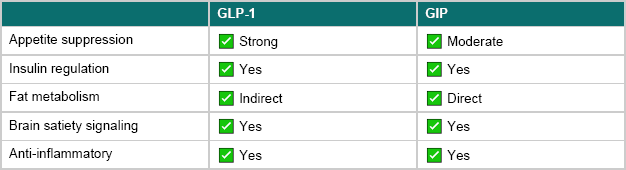
The result is a medication that works on hunger, blood sugar, fat storage, and inflammation simultaneously — which is why patients using dual agonists are achieving weight loss that was previously only possible through surgery.
What This Means for You
At Thrive Concierge Health, I approach metabolic dysfunction as what it truly is — a complex, hormonal, neurological, and inflammatory condition. Not a willpower problem. Not a lifestyle failure.
GLP-1 and GIP therapies represent one of the most significant advances in metabolic medicine in decades. When indicated, they can be transformative tools as part of a comprehensive, personalized plan that also addresses hormone optimization, sleep, stress, and longevity.
If you’re curious whether GLP-1 or GIP-based therapy may be right for you, I’d love to have that conversation.